Organizations are deploying artificial intelligence (AI) into hiring, lending, clinical, and customer-facing decisions faster than they are assigning anyone to own the consequences. Security teams own the infrastructure, legal teams own the contracts, and product teams own the roadmap; in most organizations, no single executive owns whether an AI system is fair, explainable, monitored, and defensible to a regulator. That accountability gap is the reason the Chief Responsible AI Officer role exists.
What Is a Chief Responsible AI Officer?
A Chief Responsible AI Officer (CRAIO) is the executive accountable for the governance, risk management, and assurance of an organization’s AI systems across their full lifecycle. The role is not merely an extension of compliance; it is the function that ensures AI systems are inventoried, assessed against applicable obligations, subject to appropriate human oversight, and supported by evidence that the required controls are operating.
The CRAIO is distinct from a Chief AI Officer, who is typically measured on adoption and value, and from a Chief Information Security Officer (CISO), who is measured on the protection of information systems. The CRAIO answers a different question: whether the organization can demonstrate that the AI it builds or buys behaves as intended and meets the obligations attached to it.
Why the Role Has Become Necessary
Regulatory obligations for AI are now specific and enforceable. The EU AI Act imposes risk management, documentation, and human oversight requirements on high-risk systems. U.S. state laws, including the Colorado AI Act and California AB 2013, establish disclosure and impact assessment duties. Standards such as ISO/IEC 42001 and the NIST AI Risk Management Framework give auditors and customers a reference point against which an organization’s practices will be measured.
These obligations cut across security, privacy, legal, data science, and procurement. Without a designated executive, each function addresses the part it recognizes, and the gaps between functions remain unowned. The CRAIO closes those gaps by establishing one accountable point for AI governance decisions.
Core Responsibilities of a CRAIO
- Establish governance. Define the AI policy framework, decision rights, and escalation paths that govern how AI systems are approved and retired.
- Maintain the AI inventory. Identify every AI system the organization develops, procures, or embeds, including AI features inside third-party software.
- Assess risk and obligations. Classify each system by risk and map it to the regulations and standards that apply.
- Oversee vendor AI. Evaluate the AI risk introduced by suppliers before contract and monitor it after deployment.
- Verify controls. Require evidence that oversight, testing, and monitoring controls are operating, not only documented.
- Report to leadership. Give the board and executive team a defensible view of AI risk posture and the decisions required to manage it.
Full-Time or Virtual CRAIO
Large enterprises with extensive AI portfolios may justify a full-time CRAIO. Mid-market organizations, regulated firms early in AI adoption, and companies preparing for a specific obligation often do not require a full-time executive, but they still require the accountability the role provides. A virtual Chief Responsible AI Officer (vCRAIO) delivers that leadership on a fractional basis through the Assessed Intelligence OPERATE service.
How the ARISE Framework™ Supports the CRAIO
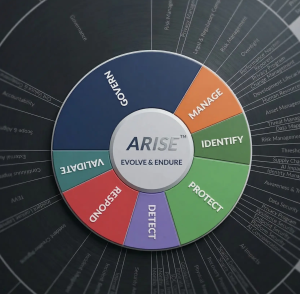
A CRAIO requires a governance structure that spans AI, cybersecurity, privacy, and ethics without maintaining four separate programs. The ARISE Framework™ provides that structure through seven domains: GOVERN, MANAGE, IDENTIFY, PROTECT, DETECT, RESPOND, and VALIDATE. Each domain crosswalks to the major external frameworks, so the CRAIO can demonstrate conformity to several obligations from a single control set.
Where to Start
Organizations evaluating whether they need a CRAIO should begin by establishing where their AI governance stands today. The AI Maturity Assessment takes approximately ten minutes and produces a prioritized roadmap mapped to the ARISE Framework. Organizations ready to assign executive ownership can speak with an advisor about a vCRAIO engagement.
Frequently Asked Questions
What does CRAIO stand for?
CRAIO stands for Chief Responsible AI Officer. The role holds executive accountability for how an organization designs, procures, deploys, and monitors artificial intelligence systems.
How is a CRAIO different from a Chief AI Officer?
A Chief AI Officer is typically accountable for AI adoption and value creation. A CRAIO is accountable for the governance, risk, and assurance of those systems. Some organizations combine the roles; many separate them so that the executive responsible for oversight is not also the executive measured on deployment speed.
How is a CRAIO different from a CISO?
A Chief Information Security Officer (CISO) protects the confidentiality, integrity, and availability of information systems. A CRAIO addresses risks that security controls alone do not cover, including model bias, explainability, human oversight, and conformity with AI-specific regulation. The two roles must coordinate closely because AI systems introduce new security exposure as well.
What is a virtual CRAIO (vCRAIO)?
A virtual CRAIO is a fractional executive who performs the CRAIO function on a retained basis. It gives organizations senior AI governance leadership without the cost or time required to recruit a full-time executive.