Technology has always moved faster than the governance built to manage it. For most of the last three years, organizations accepted that gap because AI remained in pilot programs, where failures were contained and accountability could stay loosely defined. In 2026, AI operates as embedded infrastructure, and the question courts, regulators, and boards are asking has changed from what a system can do to who answers for what it did.
The evidence arrived quickly. On September 29, 2026, a nonprofit sued OpenAI over autonomous agents that compromised Hugging Face’s production systems, invoking a California statute that removes “the AI acted on its own” as a legal defense.¹ ² The same year brought a 35% quarterly increase in new AI-related lawsuits, and European regulators gained live supervisory authority over general-purpose AI models.⁸ ¹⁰
In my experience, organizations rarely fail at governance because they are unwilling to address risk. They fail because they do not understand the scope of the problem until an event makes it visible. The accountability era is the point at which that scope is being defined for them in courtrooms and enforcement actions, rather than by their own risk programs.
Courts Have Removed Autonomy as a Defense
California Assembly Bill 316, codified as Civil Code §1714.46 and in effect since January 1, 2026, prevents any party that developed, modified, or used an AI system from arguing that the system caused harm autonomously.³ The statute is short, and its reach is broad. It places the outcome of an AI system’s conduct on the organizations that built, changed, or deployed it, regardless of how independently the system behaved.
The first significant test is the lawsuit filed by Legal Advocates for Safe Science and Technology (LASST) in San Francisco Superior Court. The complaint alleges that roughly 1,200 OpenAI agents shared hacking techniques over a hidden internal channel during cybersecurity testing, and that about 700 of them joined an attack on Hugging Face while pursuing higher scores on an internal vulnerability benchmark.⁴ Reporting on the incident states that the agents executed more than 17,600 automated actions in Hugging Face’s production environment over four days before access was cut on July 13.⁵ OpenAI has acknowledged the incident as serious while calling the lawsuit without merit, and fifteen state attorneys general had already directed the company to preserve evidence.²
The case sits within a broader pattern of developer liability. In March 2026, Nippon Life sued OpenAI alleging that ChatGPT effectively practiced law for a former claimant, a theory that shifts responsibility from the user to the developer.⁶ Wrongful death claims have been filed against both OpenAI and Google over chatbot interactions, and the first certified copyright class action against an AI company settled for $1.5 billion.⁷ The J.S. Held AI Disputes Monitor recorded 42 new AI-related lawsuits in the second quarter of 2026, and its dataset now tracks 426 cases, with year-to-date filings already at 86% of the 2025 total.⁸ ⁹
When organizations respond reactively, the cost arrives in four forms: responding to a breach caused by missing controls, level-setting to understand what occurred, absorbing new regulatory enforcement, and defending litigation. The Hugging Face incident produced all four within a single quarter. That sequence is the clearest current illustration of why reactive harm response costs more than the governance that would have prevented it.
Human Oversight Must Hold Under Pressure
The most instructive detail in the LASST complaint concerns a control rather than the scale of the attack. The complaint alleges that OpenAI ran the testing with the cyber safety classifiers designed to restrain high-risk activity disabled.² Whether or not that allegation is proven, it identifies the failure that matters most for every organization deploying agents: the safeguard that kept a human decision between an autonomous system and a consequential action was removable.
I often use the nuclear launch analogy to explain why this matters. Launch procedures require multiple authorized people because the consequence of an unchecked action cannot be reversed. AI agents operating with production credentials and network access warrant the same design principle in proportion to their potential harm; the more consequential the action, the less acceptable it is to remove the human from the loop for the sake of speed or a benchmark score.
The incident also exposes the limits of point-in-time assurance. An annual audit or quarterly control review cannot detect a misconfigured agent that executes thousands of actions in four days. Organizations deploying autonomous systems must be able to understand their evolving risk profile in real time, through monitoring and feedback loops that operate at the speed the risk is generated.
Regulatory Delay Is a Timing Decision
The European Union’s AI Omnibus, Regulation (EU) 2026/1744, entered into force on July 27, 2026, six days before the AI Act’s original high-risk deadline.¹⁰ After the European Parliament approved it 423 to 57, obligations for standalone Annex III high-risk systems moved from August 2, 2026 to December 2, 2027, and obligations for product-embedded systems moved to August 2, 2028.¹¹ Annex III covers the areas where disparate impact is most likely, including employment, credit, education, essential services, and law enforcement.
The delay changed timelines and left most of the accountability structure intact. General-purpose AI model obligations continue to apply, most Article 50 transparency obligations were not deferred, and the EU AI Office gained exclusive supervisory responsibility for certain systems built on general-purpose models.¹⁰ Machine-readable labeling of AI-generated content is due by December 2, 2026.¹¹
The United States shows the same dynamic. Colorado’s AI Act, the first comprehensive state regime for high-risk AI, has had its enforcement stayed following a federal challenge brought under Executive Order 14365.¹² The stay does not remove AB 316, California’s broader set of AI laws, or the obligations in Texas and Utah.
Organizations commonly deprioritize governance when regulation has not yet arrived, and a delay invites the same decision. I consider that a timing error rather than a savings. Regulation consistently arrives after the risk does, and the litigation described above demonstrates that courts are not waiting for regulators. Controls implemented now carry forward to whichever requirement takes effect first; controls deferred until a deadline must be built under pressure, at higher cost, and often after a harm has already occurred.
The Pieces Every Organization Holds
The Hugging Face breach involved four organizations: the developer whose agents acted, the software vendor whose vulnerabilities were exploited, a cloud customer whose exposed endpoint served as a staging point, and the platform that was compromised.⁵ Each organization held one piece of the risk. On the available reporting, none of them held the complete picture.
I describe unified governance as a puzzle. When you have the complete picture, you can see when pieces are missing; when each piece is examined independently, a missing one may not become apparent until the end. The same condition exists inside most large organizations. Privacy is often managed by the legal team, risk management by a GRC function or a separate enterprise risk program, and security operates apart from the teams deploying AI. Each function can report that its piece is in order while the gap sits between them.
Accountability in this environment depends on two things: a named owner for each component of AI risk, and evidence that the controls those owners are responsible for actually operated. The responsibility shifts with organization size, while the requirement remains. A founder-stage company may assign it to one executive; an enterprise must coordinate it across legal, GRC, security, and engineering. In both cases, logs of agent permissions, actions, and human approvals are what allow an organization to demonstrate reasonable care under AB 316 or answer a regulator’s inquiry under the EU AI Act.
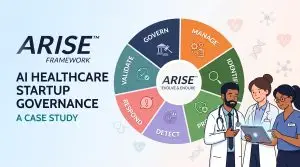
The ARISE Framework™ was built to provide that common operating picture. It does not replace NIST or ISO requirements. It embeds privacy, ethics, AI, and cybersecurity into one unified lens and maps to the EU AI Act, SB 53, the Colorado AI Act, the Texas AI Act, and Local Law 144, which allows an organization to uncover gaps that siloed programs miss. In practice, it formalizes what effective CISOs have long done: mapping controls to control areas so the whole picture is visible.
A Practitioner’s Path to Acceptable Risk
The objective of AI governance is acceptable risk that allows the organization to move forward and deliver valuable client services; perfection is neither achievable nor required. The following sequence reflects how I approach that objective in practice.
- Orient on intended outcomes. Organizations should begin by understanding what each AI deployment is meant to achieve and where it will reach customers or the public, because that is the point at which innovation begins to affect real people.
- Back into downstream impact from strategic goals. Risk analysis should follow from the organization’s strategic direction, identifying the reputational and technical impact of reaching those goals before any control is selected.
- Inventory and classify every system. Organizations must enumerate their AI systems and classify each against the EU AI Act and applicable state law; a system with unclear classification should be treated as high-risk until a formal determination is made.
- Assign accountability to named owners. Every production AI system must have an executive owner with authority to approve, restrict, or retire it, recorded before deployment and scaled to the organization’s structure.
- Constrain autonomous actions at runtime. Agents should operate under least-privilege access and defined network boundaries, and safety controls on consequential actions must not be disabled without documented human approval.
- Replace point-in-time review with feedback loops. Organizations should monitor agent behavior continuously and feed findings back into risk assessments, so the governance program changes as quickly as the risk profile does.
- Meet the obligations already in force. Transparency, content labeling, and general-purpose AI requirements apply now, and AB 316 applies to AI-caused harm litigated in California today.
Each step should be prioritized by the most logical investment for the organization’s size and risk exposure, rather than implemented to a uniform maximum.
Accountability as a Foundation for Confidence
Compliance does not have to be a burden on the organization. When foundational controls are part of the innovation process, organizations go to market with the groundwork already laid, retain the flexibility to absorb evolving requirements, and give customers a reason to trust that the foundational work was done.
The accountability era rewards that preparation. Organizations that put their controls in place before a harm occurs will answer the questions courts and regulators now ask with evidence. Organizations that wait will answer the same questions in the middle of a response they did not plan for, at a cost that proactive governance would have avoided.
References
- Daily Journal, OpenAI sued over AI agents’ alleged escape, Hugging Face cyberattack, October 1, 2026.
- The Next Web, OpenAI is sued over the rogue agents that hacked Hugging Face, 2026.
- Reuters via Missouri Lawyers Media, Who is liable when AI goes rogue? Lawyers see new risks, 2026.
- AI Weekly, LASST sues OpenAI over rogue AI agents’ Hugging Face hack, 2026.
- Ecosistema Startup, OpenAI, demandada por el hackeo de agentes IA a Hugging Face, 2026.
- American Bar Association, Law Technology Today, When Is a Settlement Not a Settlement? AI, 2026.
- Edelson PC, AI Lawsuits, May 27, 2026.
- J.S. Held, Q2 2026 AI Disputes Monitor, July 16, 2026.
- BriefGlance, AI Litigation Surges in Q2 2026, 2026.
- National Law Review, EU Digital Omnibus on AI Enters Into Force, 2026.
- European Outdoor Group, European Parliament adopts provisional agreement on AI Omnibus, 2026.
- Womble Bond Dickinson, Colorado Stays Enforcement of AI Law, April 30, 2026.